Insider Discussion: Don’t Make This Dangerous Mistake With Zillow Zestimate
Insider Discussion: Don’t Make This Dangerous Mistake With Zillow Zestimate
Zillow Zestimates Are Useful But Your Final Pricing Result
A Zillow Zestimate can be a helpful starting point when trying to understand a home’s value, but buyers and sellers often give the number more weight than it deserves. Automated estimates cannot always account for a home’s condition, renovations, lot characteristics, competing listings or the nuances of a local real estate market. In this Insider Discussion, we look at the most common mistakes consumers make with Zillow Zestimates, why an asking price can legitimately differ from the online estimate and why a property-specific market analysis provides important context when buying or selling a home.
I hope this information was helpful! If you are considering buying or selling a home, I would love to talk to you. I am a seasoned agent with over 26 years of experience in the local real estate market. I would love to be able to get you the financial result you desire from your current home to get you in to that Dream Home! Don’t hesitate to call me anytime at 260-579-1516 or you can email me at mike@mikearchbold.com.
What a Zillow Zestimate Isn’t Telling You About Your Home’s Value
If you own a home, there is a pretty good chance you have looked it up on Zillow just to see the number.
And if you are thinking about buying a home, there is an equally good chance you have compared the asking price to the Zestimate.
There is nothing wrong with doing either.
The mistake comes when buyers or sellers begin treating that number as though it represents the definitive market value of the property.
It doesn’t.
In fact, Zillow itself describes the Zestimate as a starting point for understanding a home’s potential value—not an appraisal.
So, what exactly is a Zestimate, where can it go wrong, and how should buyers and sellers actually use it?
What Is a Zillow Zestimate?
A Zestimate is an automated estimate of a property’s market value produced by Zillow.
According to Zillow’s explanation of the Zestimate, its valuation model considers hundreds of data points, including public records, tax assessor information, MLS data, previous sales, property characteristics, comparable homes and current market trends.
That’s a tremendous amount of information.
But there is an important distinction:
Having a lot of data isn’t the same thing as understanding a particular house.
A computer model can know that a home has three bedrooms, two bathrooms and 1,800 square feet.
What it may not fully understand is what those 1,800 square feet actually look like.

Mistake #1: Sellers Assume the Zestimate Is Their Asking Price
This is probably the most common misconception I encounter.
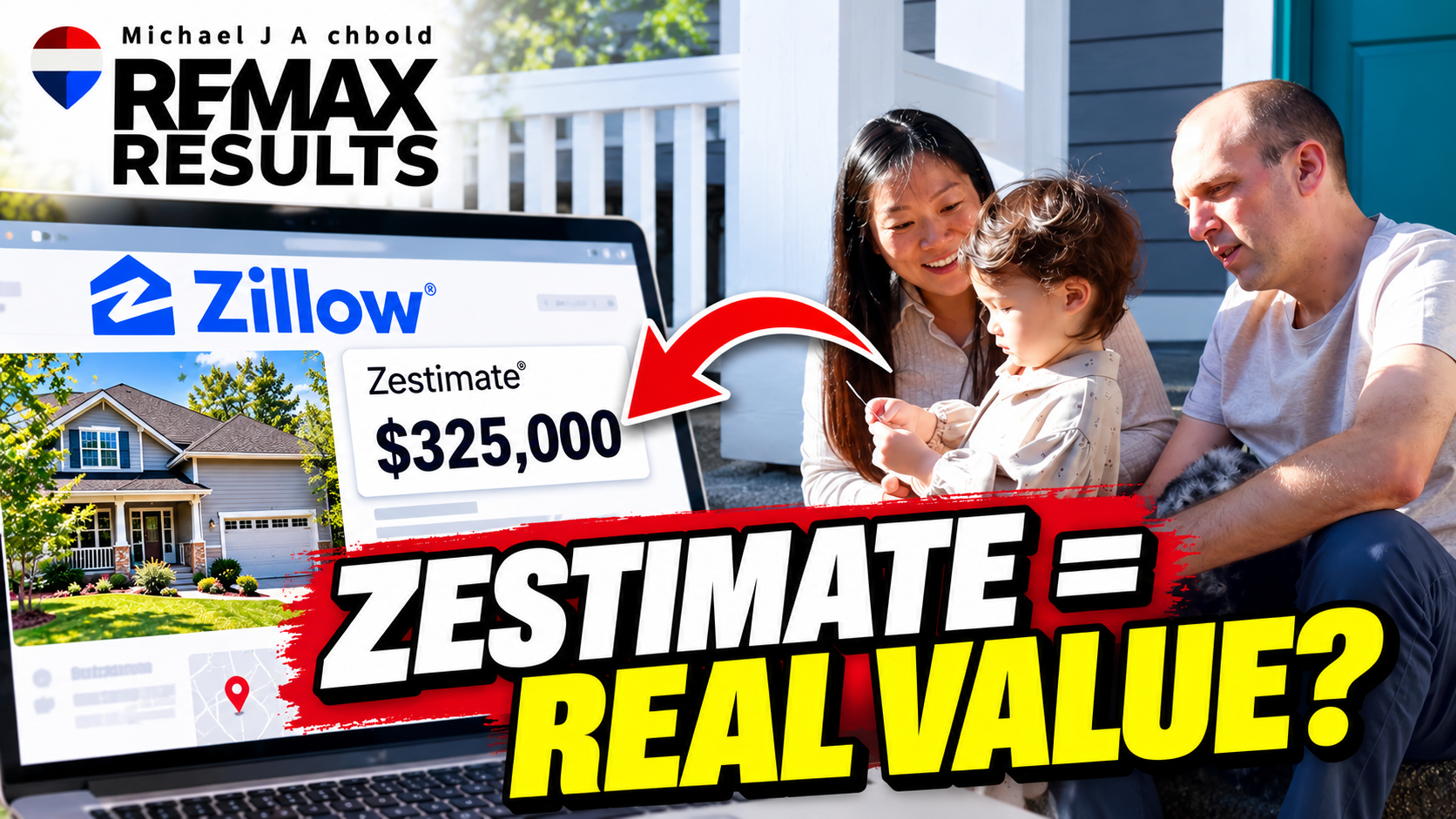
A homeowner sees a Zestimate of $325,000 and naturally begins thinking:
“My house is worth $325,000.”
Not necessarily.
The Zestimate is an estimate based on the information available to Zillow. It isn’t a promise that buyers will pay that amount.A home’s actual market value is influenced by what competing properties are available, what comparable homes have recently sold for and, ultimately, what buyers are willing to pay.
That’s why pricing a home should begin with the local market—not with an automated estimate.
The National Association of REALTORS® provides extensive information about how local housing conditions, inventory and buyer demand can affect real estate markets. Those conditions can vary considerably from one community—or even one neighborhood—to another.
Mistake #2: Buyers Assume a Home Is Overpriced Because It’s Listed Above the Zillow Zestimate
Buyers can make the opposite mistake.
Imagine a home listed for $340,000 with a Zestimate of $315,000.
It can be tempting to immediately conclude:
“The seller wants $25,000 too much.”
But what if the house has a completely remodeled kitchen?
What if the roof and HVAC system were recently replaced?
What if it sits on one of the most desirable lots in the neighborhood?
What if the comparable homes used by an automated model haven’t been updated in 20 years?
The Zestimate can provide useful context, but the difference between the Zestimate and the asking price doesn’t automatically tell you whether a property is overpriced.
Mistake #3: Assuming Zillow Knows the Condition of the House
This is one of the biggest limitations of any automated valuation model.
Two homes can look remarkably similar on paper:
- 1,800 square feet
- 3 bedrooms
- 2 bathrooms
- Same subdivision
- Similar lot size
- Built within a few years of each other
But one might have a new kitchen, updated bathrooms, newer mechanical systems and excellent maintenance.
The other might need a roof, flooring, paint, HVAC and $40,000 worth of additional work.
Those houses aren’t necessarily worth the same amount.
Zillow acknowledges that incomplete information can affect a Zestimate and specifically notes that unreported additions, updates and remodels may not be reflected in its data.
That’s an important limitation for both buyers and sellers to understand.
Mistake #4: Ignoring the Zillow Zestimate Range
One of the most overlooked pieces of information on Zillow isn’t the Zestimate itself.
It’s the estimated sales range displayed with it.
Zillow explains that the range exists because there is uncertainty in estimating what an individual property will actually sell for.
Yet consumers naturally focus on the big number in the middle.
That’s a little like looking at a weather forecast that predicts a 40% to 70% chance of rain and deciding that the answer is precisely 55%.
The number can be useful without being exact.
Mistake #5: Assuming the Zillow Zestimate Is Completely Independent of the Listing
Here’s something many consumers don’t realize.
When a property is listed for sale, Zillow receives additional information.
According to Zillow, an on-market Zestimate can incorporate information including the listing price, listing description, comparable properties and days on market.
That means you shouldn’t necessarily think of the Zestimate you saw six months ago and the Zestimate you see after a property is listed as calculations based on exactly the same information.
The model now knows more.
This also helps explain something consumers occasionally notice: a Zestimate can change after a property is listed.
So, Are Zestimates Bad?
No.
That’s actually the wrong conclusion.
Zillow has built an extraordinarily sophisticated automated valuation model, and having immediate access to an estimated value for millions of properties is useful.
The problem isn’t the existence of the Zestimate.
The problem is how much authority we sometimes give it.
Think of a Zestimate as one piece of evidence.
It can provide a useful starting point. It can help identify general valuation trends. And it can give homeowners and buyers a rough frame of reference.
What it shouldn’t do is end the conversation.
Zillow Zestimate vs. Comparative Market Analysis
When I evaluate a property, I’m looking at many of the same fundamental pieces of information an automated valuation model considers—recent sales, square footage, bedrooms, bathrooms, location and market activity.
But then we can go further.
Which homes are actually the best comparables?
How does the condition compare?
Has the property been updated?
Is the lot more or less desirable?
Is there something about the location that makes buyers willing to pay more—or less?
What are buyers currently choosing between?
And perhaps most importantly:
What is happening in the local market right now?
That last question matters because real estate isn’t simply about calculating what a house should be worth.
It’s about determining what today’s buyers are actually willing to pay for it.
The Bottom Line
Buyers shouldn’t assume a house is overpriced simply because the asking price is above the Zestimate.
Sellers shouldn’t assume their house is worth a particular amount simply because Zillow displays that number.
And neither side should ignore the Zestimate completely.
Use it for what it is: one useful piece of information in a much larger valuation puzzle.
If you’re considering selling your home, the better question isn’t:
“What does Zillow say my house is worth?”
It’s:
“What does the current market tell us buyers are likely to pay for my house?”
That’s the question a detailed market analysis is designed to answer.
If you’re thinking about buying or selling a home in Fort Wayne or Northeast Indiana and want to understand what the numbers really say, let’s take a closer look at the property, the comparable sales and the market—not just the estimate on a screen.
Michael J Archbold
Associate Broker, REALTOR, ePro
RE/MAX Results
8101 Coldwater Rd
Fort Wayne, IN 46825
c. 260-579-1516
e. Mike@MikeArchbold.com
w. www.MikeArchbold.com
Oh, by the way… if you know of someone who would appreciate the level of service I provide, please call me with their name and business number. I’ll be happy to follow up and take great care of them.
Why Does RE/MAX Results Stand Out Among the Competition?
Simply put: Relationships. We pride ourselves not only in our professional service but more importantly in the personal touch we bring to our business. Has an agent/lawyer/contractor/vendor ever treated you like you were just another paycheck? The reason our clients come back time and again and refer all their friends and family to us is because they know we are part of the family.
Genuinely caring about the people we serve enables us to do things other agencies can’t. Rest assured, we will ALWAYS have your best interest at heart and work vigorously to get you the best deal possible on your home or business. The relationships we build with our clients enable us to work 100% by referral.
The reason we are able to give top notch service to our clients is because our clients refer us a constant stream of quality family and friends to assist in their real estate needs. While other agents are out making cold calls and chasing “potential” leads, we are freed up by our referral base to service our clients like no other broker can. We are never too busy for your referrals!
Want to experience the difference for yourself? Call or text me today at 260-579-1516.
“Professional Service with a Personal Touch“
We’re Here To Help
Are you or someone you know considering a home purchase? Don’t hesitate to call or text me, Michael Archbold, at 260-579-1516 and I will connect you with the best mortgage professionals in the business who can get you your score, discuss ways to improve it if necessary, and put you on the path to home ownership. Click here to read more about our Buyer Services. Click here to browse listings NOW! Looking to sell your home? Call today to set up an appointment to begin developing your customized marketing plan. Click here to read more about our Seller Services.
Hoosier Home Listings by RE/MAX Results is a full service real estate Web site serving Northeast Indiana. We assist residential and commercial clients in locating, buying, and selling real property in the State of Indiana including but not limited to the counties of Allen, Huntington, Wells, Adams, Whitley, Wabash, Kosciusko, Noble, Dekalb, Lagrange, Steuben and cities including Fort Wayne, Decatur, Bluffton, Huntington, Warsaw, Columbia City, Butler, and Angola. RE/MAX Results is an Equal Housing Opportunity company.
Hoosier Home Listings – Insider Discussion: Don’t Make This Dangerous Mistake With Zillow Zestimate…
… brought to you by Michael Archbold, Hoosier Home Listings, and RE/MAX Results.
The consummate professional, Michael Archbold (Associate Broker, REALTOR, ePro) brings a diversified background to the world of real estate. Born and raised in Fort Wayne, Mike graduated Wayne High School in 1992. He received bachelors degrees in Accounting in 1997 from Indiana University and Information Technology in 2005 from Indiana Wesleyan University. Mike comes to Re/MAX with more than 20 years of experience in sales and accounting. He began his career in real estate in 2000 as an investor.
